

US urges New Delhi to align its nuclear liability law with the international convention

The old Parliament building will now be known as 'Samvidhan Sadan', Lok Sabha Speaker Om Birla said on Tuesday as the functioning of Parliament shifted to its new building in New Delhi.
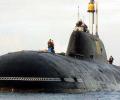
China on Tuesday angrily denounced the nuclear-powered submarine deal announced by the US, UK and Australia, saying the pact violates the Non-Proliferation Treaty (NPT) and the three countries are travelling "further down the dangerous and wrong path."

During the talks with Prime Minister Narendra Modi, French President Francois Hollande reassured reliable, uninterrupted and continued access to nuclear fuel supply throughout the entire lifetime of the plants while acknowledging India's need for the same.

Khamenei said: "We do not violate the deal, but if the other party violates it, if they tear the agreement up, we will light it on fire."

Weeks after 'breakthrough', substantial work is yet to be done
Strategic guru K Subrahmanyam, who passed into the ages recently, discusses the history of India's nuclear weapon programme in a fascinating interview.

The Indian position on the Russia-Ukraine war and the unconditional treaty between China and Russia appear to have caused some ripples in India-US relations and led to a reappraisal of India's usefulness to the US in the eventuality of a conflict with China, notes Ambassador T P Sreenivasan.

Attending the Nuclear Security Summit for the first time, Modi is expected to lay out his vision of securing nuclear weapons.

20 years ago this day, May 11, 1998, India conducted its second nuclear test at Pokharan in Rajasthan. In a fascinating interview on Rediff.com, K Subrahmanyam revealed how Indian PMs reacted to nuclear ambitions.

India has voted against the provisions of draft resolutions that would have required it to accede to the Nuclear Non-Proliferation Treaty, saying there is "no question" of it joining the treaty as a non-nuclear weapon state.
Ahead of Prime Minister Manmohan Singh's visit to the United States, a controversy has broken out over the nuclear liability law with reports suggesting that an agreement will be signed which may not be in tune with the law.
Discussions covered a wide range of issues, including global nuclear non-proliferation challenges.
The oil spill in the Gulf of Mexico and the Bhopal tragedy have brought back into focus the issue of industrial accidents, contractual liabilities and questions of operator liability, notes Manoj Kumar and Lydia Powell in an Observer Research Foundation study, which will be published in a three-part series. Here goes the first part:
The India-Japan civil nuclear deal might not fructify anytime too soon, with Prime Minister Manmohan Singh acknowledging that India was keenly aware of Japanese sensitivities on the matter and "would not like to force the issue".Dr Singh was addressing a business luncheon attended by top leaders of business and industry from India and Japan in Tokyo on Monday.
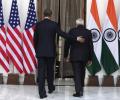
"Prudence and caution" needs to be exercised, warns China.
The Bharatiya Janata Party on Friday said the text of the nuclear agreement with the United States has confirmed its fears that India's right to nuclear testing will be impacted.
They have agreed to include two major aspects of licence renewal and risk-informed regulation in the ambit of the ties.
"The ultimate aim should be to have at least four such submarines so that at least one, if not two, are on patrol duty at all times," said Padmanabhan.
'More than a decade after Pokharan II, India doesn't have much to celebrate. It still doesn't have minimal, let alone, credible deterrence,' says Brahma Chellaney.
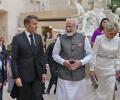
India-France synergy is poised to open vistas of collaboration between the two countries, notes Rup Narayan Das.

India and the United States have reached the first commercial agreement on civilian nuclear power, five years after a landmark deal between the two countries was clinched.

The synergised demonstration of indigenous defence capabilities during 'Bharat Shakti' is a "testimony to its commitment towards modernisation through indigenisation," the sources said.

The two countries also asked all nations to stop cross-border movement of terrorists and asserted that a decisive collective response from the international community without 'double standards and selectivity' was required to combat the threat of terrorism.
"India's defence and strategic affairs have to be decided on the basis of continuity and national consensus with due deliberations. These are issues best kept above partisan politics," the PM said.

If Modi wants to leave a real legacy, breaking India's strategic triangulation would be the real gift, notes Shekhar Gupta.
Appreciating India's track record on the non-proliferation front, Japan on Friday expressed keenness to conclude the civil nuclear agreement with it at the earliest, but made it clear that such cooperation would be suspended if New Delhi conducted an atomic test.With one round of negotiations on nuclear cooperation already having been concluded, External Affairs Minister S M Krishna and his Japanese counterpart Katsuya Okada discussed the issue.
Senior Indian and Pakistani officials will meet in Islamabad on December 26 and December 27 for talks on nuclear and conventional confidence-building measures as part of the bilateral dialogue process. This will be the first meeting of the Joint Working Group on nuclear and conventional CBMs in over four years though other officials, including the two Foreign Secretaries, have discussed these issues in recent meetings in Islamabad and New Delhi, diplomatic sources said.

'If he were to drop even one nuclear weapon on Europe, it would start a nuclear war that would destroy everybody.'

'There has definitely been a breakthrough in the nuclear logjam. It is good to see nuclear energy back on the rails,' says Dr Anil Kakodkar, former chairman, Atomic Energy Commission.
India has said that it has difficulty with parts of the IAEA draft.

'Imagine a scenario where a terror strike by Pakistan-supported jihadis causes thousands of deaths in India. India in retaliation destroys terror camps in Pakistan occupied Kashmir.' 'There is a clamour for revenge in Pakistan and that country begins to fuel its missiles for a nuclear strike against India and that is detected by Indian satellites.' 'No sane government in India will then wait for the nuclear bombs to fall on Delhi before launching its own strike. To be effective, this may well involve nuclear weapons.' Colonel Anil A Athale (retd) says the change in the 'No First Use' pledge in the BJP manifesto is long overdue.
The People's Movement Against Nuclear Energy, leading the protest against the Koodankulam Nuclear Power Plant, on Saturday threatened to sue the Prime Minister's Office for linking the stir to foreign funding.
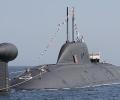
Defence Minister A K Antony has asked the Navy and the DRDO to maintain highest safety standards in the nuclear submarine fleet of the country after the mishap at the site of an under-construction vessel at Vishakhapatnam in which one person was killed.
The Supreme Court on Friday sought the government's reply to a plea challenging various provisions of the controversial Civil Liability on Nuclear Damage Act.
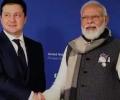
Prime Minister Narendra Modi spoke with Ukrainian President Volodymyr Zelenskyy on Tuesday and asserted that there can be no military solution to the Ukraine conflict, while also underlining that endangerment of nuclear facilities could have catastrophic consequences.

The reimposition of sanctions on Iran will have major impact on countries like India, with which it has traditional and historic trade relationship.

Australia's Prime Minister Tony Abbott on Friday said he will sign an agreement with India to sell uranium for non-weapon use. "Prime Minister Modi and I will today sign a nuclear cooperation agreement that will finally allow Australian uranium to India," he said while addressing a meeting, organised by industry chambers including CII and Ficci.

Although the pact would focus mainly on the Pacific and the South China Sea region, any action designed to deter China with or without New Delhi's active participation is a welcome move, notes Commodore Venugopal Menon (retd).
